
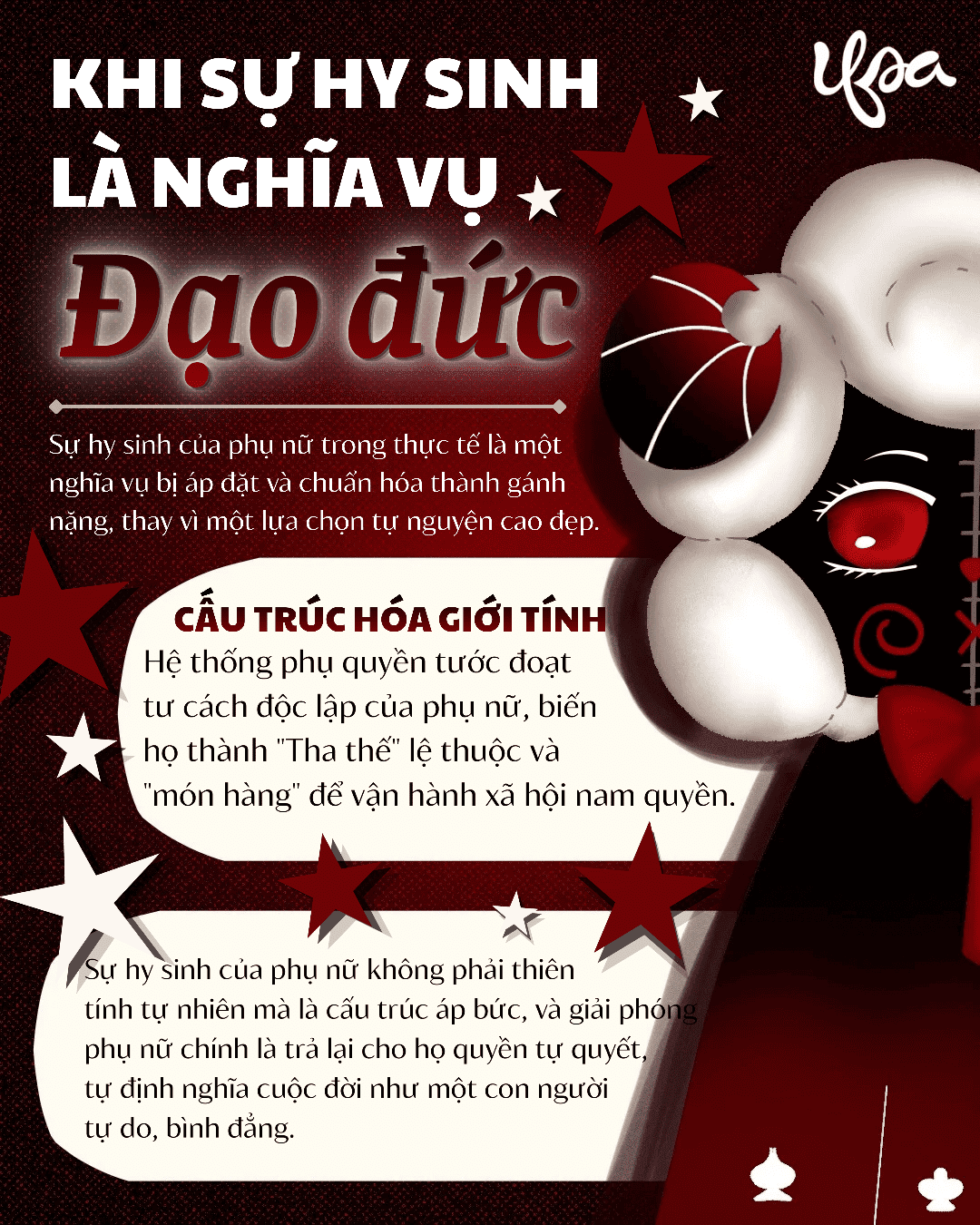
In the dictionary of kindness, sacrifice would surely be bolded and placed under the first and most solemn heading. Yet in reality, it often appears in a less radiant form: an inescapable moral duty. Sacrifice is present in habits so small and ordinary that we forget to question their fairness—normalizing imposed expectations until they become an inevitable part of life.
Looking at kitchens that are always warm with fire, where domestic labor is automatically treated as women’s own “territory,” cooking is not recognized as a legitimate contribution of labor, but rather as a compulsory model of virtue. We are also all too familiar with the image of a woman instinctively apologizing, even when she is the one who has been disadvantaged or the victim of injustice. In this way, society has packaged the concept of “femininity” into a set of moral instructions: to be a girl is to be gentle, to yield, and to measure one’s self-worth by one’s devotion to others.
Why must kindness be forced to become a burden? Why does sacrifice—originally a noble and voluntary act—turn into a sentence that binds women to invisible duties?
I. THE STRUCTURING OF GENDER: THE OTHER, THE COMMODITY, AND THE SYMBOL OF SACRIFICE
In The Second Sex, Simone de Beauvoir conceptualized women as the Other from the perspective of a patriarchal social order, one that organizes human beings within a hierarchical social system [1]. Within this system, men automatically occupy the position of the Subject: he represents the fundamental, universal human being and serves as the measure of all standards of value. By contrast, women are pushed into the position of the Other, defined only in relation to men. In this way, men occupy the position of the Subject, with the power to define themselves, while women are not treated as individuals who exist independently. Women are not encouraged to define themselves through their own personal aspirations. Instead, they are taught to seek the meaning of life through devotion, obedience, and self-giving. They are taught to believe that the happiness of others is the highest achievement of their own lives.
Within this system, women’s sacrifice has been morally encoded through a form of compulsory cultural discipline, becoming what is often called “feminine nature” or “female instinct.” Yet it is precisely these beautiful-sounding labels that normalize oppression, allowing injustice to be idealized and rendered “natural.” In reality, sacrifice is not an autonomous choice made by women. Rather, it is a choice imposed by a predetermined gender hierarchy, one that they must follow in order to be accepted by patriarchal society. As Beauvoir herself famously stated, “One is not born, but rather becomes, a woman” [1]. Women are not born to assume the role of sacrifice; they are raised to embody these so-called “feminine” qualities. Ultimately, without “femininity,” how could we ever define “masculinity”?
Luce Irigaray, in her book “This Sex Which Is Not One” further developed the understanding of gender stratification by analyzing women within the context of men’s political economy and symbolic order as commodities [2]. At this point, women’s sacrifice is no longer merely a matter of personal morality, but a structural requirement for the functioning of society.
Within a patriarchal system built upon bonds among men, or homosociality, men are conceived as the Subjects of exchange: they hold the power to establish the rules of the game, to possess value, and to circulate it. Women, by contrast, are positioned as the Objects of exchange, serving as mediating instruments through which men form social, economic, and political alliances. The bodies and labor of women are therefore exchanged among male-dominated institutions such as the family, the economy, and the state. In marital alliances, a woman is “transferred” from her father to her husband. Her reproductive capacity is turned into a tool for maintaining male lineage and inheritance. Women’s bodies and labor become a free resource, serving both the reproduction of men’s labor power and the desires of the Subject of exchange. Most importantly, like an inanimate commodity, women are stripped of their individual personhood and reduced to a social function.
These “commodities”—women—are nevertheless indispensable to the Subject of exchange. Women hold value as symbolic resources that help stabilize male identity and social bonds. Just as one can only recognize the category of green light through its contrast with the category of red light, women’s sacrifice becomes a structural requirement for maintaining the definition of patriarchal social order. Although the social system depends entirely on women’s sacrifice and labor in order to survive, their contributions are often rendered invisible or treated as self-evident—as compulsory duties, or as the so-called “natural calling” of women.
Women’s sacrifice is the very “fuel” that keeps the patriarchal machine running. Women are trapped between being framed as commodities to be exchanged and moral symbols to be worshipped; yet in both images, they are never truly recognized as autonomous individuals with their own will and independence.
II. COMPROMISE AS A STRATEGY FOR SURVIVAL
After examining women’s position as the “Other” or as a “commodity,” we need to ask: why does this system continue to operate so persistently, and why does it receive compromise from the very people it disadvantages? Deniz Kandiyoti’s concept of the “patriarchal bargain” provides a practical lens through which to decode sacrifice not only as an imposition, but also as a survival strategy [3].
The patriarchal bargain is a term used to describe the strategies and coping mechanisms that women employ to navigate, maximize their safety, and expand their available life choices while negotiating the specific constraints of the patriarchal system.
Here, Kandiyoti defines the patriarchal system not merely as an abstract and unified entity, but as a game-like condition established by men, operated through men’s defining power, and naturally inclined to serve men’s interests. Within this game, different social structures continuously impose their own “rules” on women, shaping and controlling their subjectivity, gender ideology, and forms of resistance. These rules may take the form of demands for chastity, compulsory domestic duties, or endurance in the face of violence. At the same time, these “rules of the game” are not static; they constantly transform in order to maintain control over female subjects.
Women accept and perform socially approved roles as a form of currency for exchange. Performing these roles well—from the obedient wife to the devoted mother—is a purposeful act: it is exchanged for safety and a small measure of power within the game of the patriarchal system. In this way, women are not merely passive pawns; they also actively develop subtle strategies and hidden “scripts” to optimize their personal circumstances.
However, this agency still operates within the boundaries of a system over which women have no real control. Women often enter these bargains from lower social and economic positions. Due to their lack of actual power, the outcome of such negotiation is always asymmetrical. Women are forced to trade core values such as autonomy, labor, and human rights in exchange for specific forms of protection that are granted to them as privileges rather than guaranteed as rights. This represents a profound human rights disadvantage, as they are compelled to surrender the self in order to secure mere survival.
This asymmetry appears most clearly in traditional patriarchal models in certain regions of Asia and the Middle East, where the exchange often involves a long-term trade-off: women give up their present autonomy in return for the promise of future stability. Many women relinquish their legal right to inherit property from their fathers, “gifting” it instead to their brothers in the hope of receiving favor and a place of refuge from their natal families should their marriages later collapse. In another case, a woman may refuse the right to earn her own income in order to devote herself entirely to domestic work. She accepts becoming a dependent subject in exchange for a promised source of financial provision from men—one that is regarded as “safe and stable” enough to sustain her life.
However, bargaining with patriarchy is not a “get-out-of-jail-free card”; it also has its own limits in protecting women within closed patriarchal power structures. When women accept the “rules of the game” in exchange for certain benefits, they unintentionally affirm the legitimacy of the patriarchal system. This, in turn, creates the risk of reproducing inequality, allowing patriarchal structures to continue existing and functioning. In the same way, the hidden “scripts” that women develop—when repeated through acts of resistance within the system and through scattered, limited opportunities—may gradually become normalized, thereby continuing to sustain and reproduce injustice. Becoming trapped in individual bargains can also erode the will for collective resistance. When personal safety is prioritized, movements aimed at dismantling oppressive structures become more difficult, because genuine transformation requires breaking existing limits rather than compromising with them.
However, bargaining with patriarchy is not a “get-out-of-jail-free card”; it also has its own limits in protecting women within closed patriarchal power structures. When women accept the “rules of the game” in exchange for certain benefits, they unintentionally affirm the legitimacy of the patriarchal system. This, in turn, creates the risk of reproducing inequality, allowing patriarchal structures to continue existing and functioning. In the same way, the hidden “scripts” that women develop—when repeated through acts of resistance within the system and through scattered, limited opportunities—may gradually become normalized, thereby continuing to sustain and reproduce injustice. Becoming trapped in individual bargains can also erode the will for collective resistance. When personal safety is prioritized, movements aimed at dismantling oppressive structures become more difficult, because genuine transformation requires breaking existing limits rather than compromising with them.
III. BEHIND THE SHADOW CAST BY THE WORD “ANGEL”
In 1854, the English poet Coventry Patmore published the poem “The Angel in the House,” which gained widespread influence as a model that shaped the expectations and standards imposed on women by the Victorian middle class at the time.
Who would an angel be if she were no longer perfect or virtuous? Women were called “angels” for precisely this reason. According to Patmore, she had to be sensible, sweet, gentle, filled with boundless love, selfless in her kindness, pure in her moral thoughts, more patient than the body itself could endure, nurturing in temperament, and wholly devoted to the home. Her “perfection” and “virtue” were, in essence, a form of sacrifice: the sacrifice of the Self, so that she could be completely fulfilled in her role and position as a housewife, carrying out her moral duty to serve her husband and children, rather than cultivating her own supposedly selfish individuality and personal ambitions. In this sense, she was the perfect embodiment of an “angel” residing within the house—the very place where she had always been told she naturally and properly belonged.
In Victorian society, which was confronting dizzying changes brought about by public life, factories, cities, and capitalism, private life within “the house”—her designated space—became the final refuge of the “purity” of human virtue. Accordingly, she was also entrusted with the responsibility of nurturing and protecting it. “In the drawing room, beside the tea table” was where moral and cultural values were placed firmly in her hands. Her calling was not limited to domestic tasks such as washing dishes or wiping tables; it also became a form of domestic moral authority, through which she was expected to judge every moral aspect of society’s institutions—spaces of privilege that had otherwise belonged entirely to men.
Yet has it not been overlooked that the qualities of the angel—her “perfection” and “virtue”—were never self-evident, but rather an identity assigned to women as a form of compulsory cultural discipline? By sanctifying Victorian expectations imposed upon women, society was able to justify and rationalize the deprivation of her legitimate rights, such as freedom, economic independence, sexual self-determination, and so on. After all, how could an angel still be considered a “person” who could vote, complain, or demand wages? In the end, the figure of the angel turns out to be nothing more than the remnant of an earthly woman, destroyed by a gender ideology.
In 1931, Virginia Woolf once described “the Angel in the House” as a ghost lingering beside the writing desk, whispering sweet words of advice: be selfless, be modest, be pleasant, and be obedient. In that moment, Woolf made her choice: “She had to be killed.” Perhaps that was indeed the proper way to deal with an outdated ideal—a double standard that could no longer be anything more than the expression of a toxic masculine society. The Angel in the House continues to whisper into the ears of women in every age, because her essence is no longer that of a living existence, but of an ideal: a psychological illness that holds women back, preventing them from ever desiring, or becoming, anything beyond it.
But everything will be all right. She knows this. As long as she still believes—and dares to believe—in herself.
IV. CONCLUSION
Looking back on the journey from Simone de Beauvoir’s notion of women as the “Other,” to Luce Irigaray’s conception of women as “commodities” within a system of exchange, and finally to Deniz Kandiyoti’s theory of “patriarchal bargains,” we come to recognize a stark truth: women’s sacrifice has never been an inherent moral duty. In essence, it is a structure carefully constructed to maintain the order of patriarchal society. When society encodes devotion as “feminine nature” or “virtue,” it is, in effect, stripping women of the right to exist as independent subjects. Instinctive apologies, hidden scripts in the kitchen, or the surrender of personal rights are not expressions of some default nobility, but the consequences of an unjust game that women are forced to enter in order to survive.
There is no moral duty that requires one gender to suffer disadvantage in order to serve as the foundation for the existence of another. Sacrifice only holds true value when it is a voluntary and conscious choice, grounded in personal freedom, rather than a debt to be paid for the title of “woman.” Recognizing these “bargains” and “patterns” is not meant to deny kindness, but to return to women the right to live as universal human beings—subjects who define themselves, make their own decisions, and are no longer bound by the virtue of sacrifice.
REFERENCES:
[1] Simone de Beauvoir (1949) The Second Sex
[2] Luce Iragaray (1985) The Sex Which Is Not One
[3] Deniz Kandiyoti (1988) Bargaining With Patriarchy
Author: Nguyen Tran Gia Linh

 English
  Vietnamese
Leave a Reply