
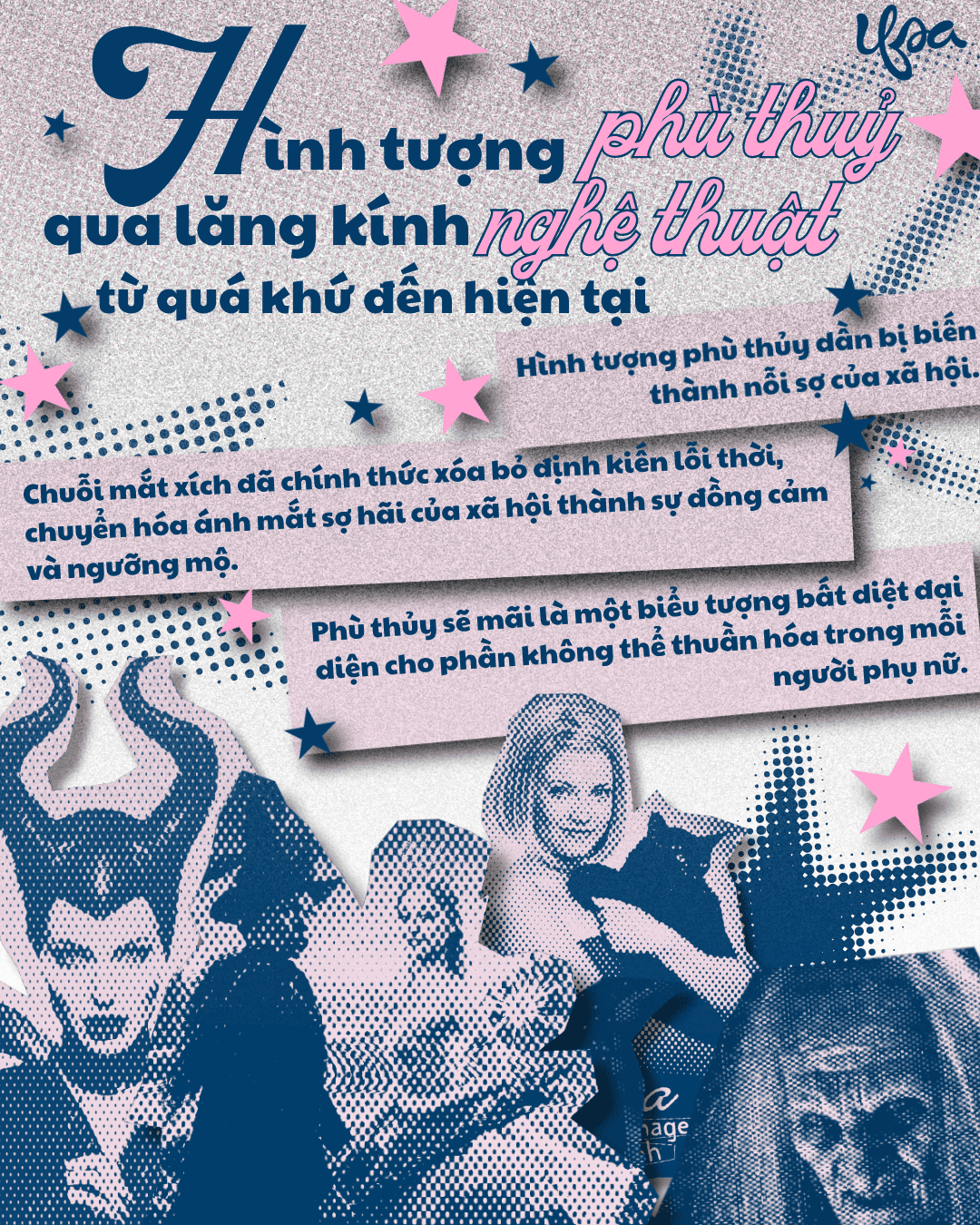
In the childhood memories of many generations, the figure of the witch—portrayed in stories such as Snow White or Hansel and Gretel—often embodies evil, grotesqueness, and acts of poisoning. Perhaps for this reason, throughout the course of history, women—who were associated with the image of the wicked witch—had to live under society’s hatred, constantly carrying within them the fear of being restrained or even deprived of their lives. Yet the figure of the witch has gradually stepped out of the darkness of stigma to become a symbol of women’s autonomy and power. This transformation is clearly reflected in women’s continuous struggles, especially through works of cinema and literature.
I. THE HISTORY OF THE WITCH HUNT MOVEMENT
From a long-standing fear of demons and supernatural forces, medieval European society gradually formed a belief system that associated magic with heresy and Satan, leading to the rise of witch hunts. As early as the eleventh to fourteenth centuries, these ideas had developed strongly, turning vague suspicions into religious and legal accusations, and laying the groundwork for later witch hunts. Within this context, the publication of Malleus Maleficarum — roughly translated as The Hammer of Witches — by Heinrich Kramer in 1486 was not only a crucial turning point that reinforced such fears, but also a text that legitimized the killing of women in the name of religion [1].
Over the three centuries from 1450 to 1750, fabricated stories began to spread widely. Absurd accusations—such as replacing newborn babies or depriving men of their masculinity—were, in reality, a mask used to eliminate women who existed beyond the control of the dominant ideology. These were women who lived independently, possessed knowledge, understood healing practices, or worked as midwives.
From this point onward, the figure of the witch was gradually transformed into an object of social fear. Women labeled as witches were framed as mad, ugly figures who rode broomsticks or made pacts with the devil. This distortion inflamed extreme imagination, turning the title of “witch” into a death sentence for thousands of innocent lives. Even after witch trials were abolished, this ghost continued to haunt popular culture through horror films and Gothic novels. From Abigail Williams in The Crucible to Thomasin in The Witch, women continued to be portrayed through loneliness and wildness—as beings born to be feared, judged, and hunted.
II. THE TRANSFORMATION OF THE WITCH FIGURE IN CINEMA AND LITERATURE
In the face of the powerful vitality of progressive social movements, the seeds of that fear gradually began to wither, opening a new chapter of understanding and the restoration of dignity.
The first turning point came in the 1960s with the television series Bewitched, which served as a lens reflecting the profound social transformations taking place in the United States during that decade. The series used magic as a metaphor for women’s power and independence within a patriarchal social context. The protagonist, Samantha Stephens, is a witch who appears to be an ordinary middle-class woman. She represents the image of the modern woman torn between the role of a traditional housewife and that of a person with extraordinary abilities, as she is often forced to conceal her magic in order to please her husband, Darrin. It can be said that the work not only reflected the pressure to conform and the suppression of women’s intellect at the time, but also played an important role in the journey of redefining the witch figure—from a frightening villain into a symbol of feminism and autonomy [2].
The year 1964 saw the publication of The Feminine Mystique, written by Betty Friedan. The work directly challenged patriarchal structures and became a spark that encouraged women to break free from outdated chains of power within both the family and the workplace. The book laid the groundwork for women’s rise in reclaiming justice, eliminating violence, and dismantling traditional social stereotypes about women’s work and their position within the family. Influenced by these echoes, 1968 witnessed the first protest organized by W.I.T.C.H.—Women’s International Terrorist Conspiracy from Hell—on Halloween night, when its members dressed as witches and marched down Wall Street to challenge patriarchal domination across the United States. This event marked the moment when the image of the witch was incorporated into the feminist movement and became a stepping stone for subsequent protests [3].
By the 1970s, Stephen King’s Carrie offered a much harsher perspective by portraying the witch as a victim of repression and social violence through its protagonist, Carrie. Unlike the pretty and gentle image of Samantha Stephens, Carrie is depicted as an outcast and a violent figure, rejected not only by her peers but also by her own mother. Rather than spreading baseless fear, the work forces viewers to confront empathy and to recognize that explosive power can sometimes be a form of resistance by individuals who have been pushed to the very edge [4].
Entering the 1990s, films such as Sabrina the Teenage Witch and The Craft continued to soften the image of the witch by associating magic with the process of growing up and searching for personal identity. In both works, the witch figure became more relatable to younger generations, as the characters used their powers to beautify themselves and to confront school bullying. Unlike earlier images of the witch as frightening or repressed, here the witch is portrayed with a gentler and more feminine quality. Through these two representative examples, readers can see that power and femininity are not separate elements, but rather harmonize within a new image: the modern witch.
The intellectual revolution truly reached its peak in the twenty-first century through two milestones: Wicked and Maleficent. If Elphaba in Wicked overturns the conventional understanding of good and evil, proving that “wickedness” is often merely a label imposed by the crowd upon those who dare to resist, then Maleficent completes this portrait by exposing the wounds and powerful protective instincts hidden beneath a thorny exterior. This chain of transformation officially dismantled outdated prejudices, turning society’s fearful gaze into empathy and admiration for women who had been misunderstood for centuries.
These changes are the accumulation of countless powerful voices—those who dared to stand up, to speak out, to change their own destinies, and to challenge outdated perceptions that had seemed deeply rooted in society.
III. A NEW SOCIAL PERSPECTIVE
Every struggle for women’s rights, through even the most persistent efforts, has gradually opened the chapter we now inhabit—a chapter of liberation and the redefinition of identity. In the contemporary context, the figure of the witch no longer lurks in the darkness of fear, but gradually steps into the light as a symbol of power and independent individuality.
Sự trỗi dậy của lối sống gắn liền với tinh thể, đá quý hay nghệ thuật Tarot đã hình thành nên khái niệm “phù thủy hiện đại” (modern witchcraft). Những thực hành này không còn bị xem là dị giáo hay mê tín, mà được mọi người đón nhận như một cách thức để con người kết nối lại với bản thể và vũ trụ. Việc tìm hiểu về ma thuật giờ đây là một nét văn hóa thú vị, một hành trình tìm kiếm sự an yên giữa thế giới đầy biến động và là một cách giúp con người tìm ra định hướng trong tương lai. Dù góc nhìn của xã hội với phép thuật đã cởi mở hơn, ngày nay, trên thế giới vẫn tồn tại những khu vực nơi định kiến về tà thuật gây ra bạo lực cho phụ nữ. Tại Ghana, cho đến nay vẫn tồn tại những khu tập trung phù thủy như Kukuo, Tindang, Gushiegu với hàng trăm người. Những phụ nữ bị cáo buộc là phù thủy bị bắt và thiêu sống vì người dân tin rằng nếu không thiêu đốt thân thể phù thủy, họ sẽ đội mồ sống dậy [5].
It can be said that the journey of the witch from villain to feminist symbol serves as a mirror reflecting women’s relentless efforts to reclaim their freedom and happiness. The struggle is far from over, yet the witch will remain an enduring symbol because she represents the untamable part within every woman—a reminder that true power lies in daring to be different and daring to rise up, both for oneself and for other women.
Author: Le Tran Gia Linh
 English
  Vietnamese
Leave a Reply