
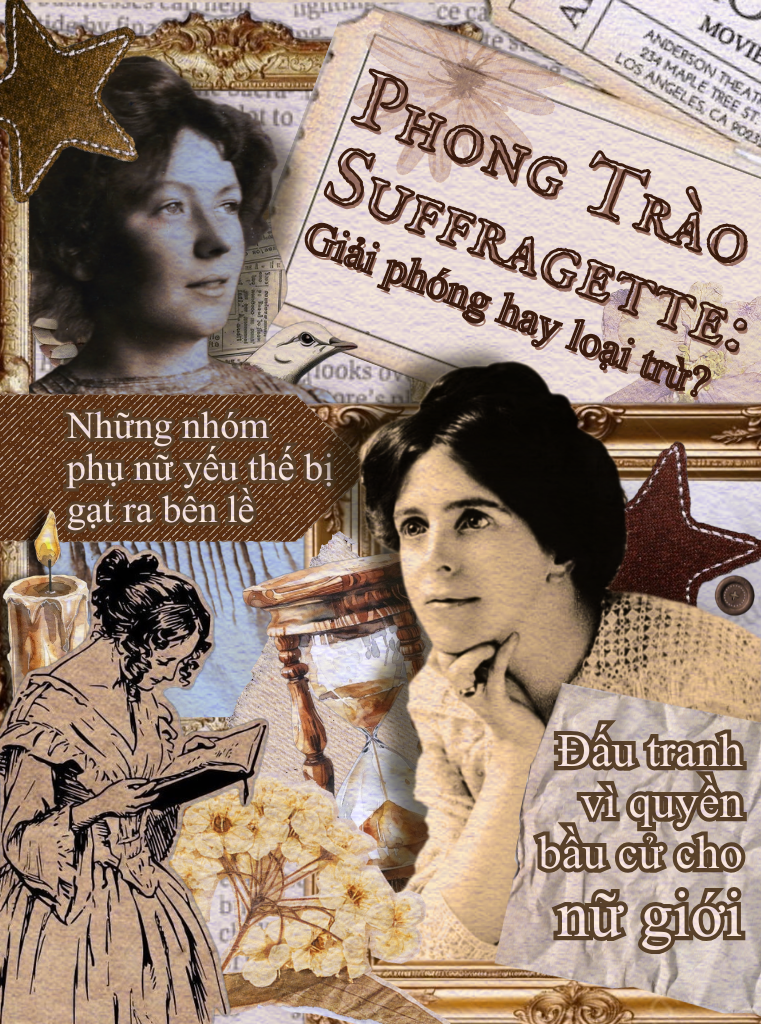
The Suffragette movement of the early twentieth century is often remembered as a radiant symbol of the struggle for women’s rights. The crowds marching through the streets and the banners bearing the words “Votes for Women” have become legendary. Yet few pause to ask: was this liberation truly meant for all women? Behind that radiance, were there still lives left behind?
I. HISTORICAL CONTEXT AND THE GAPS WITHIN THE WOMEN’S MOVEMENT
In the late nineteenth and early twentieth centuries, at a time when Western women had almost no voice in politics, – denied the right to vote and excluded from participation in public decision-making, the Suffragette movement emerged as a powerful wave of resistance. The movement focused on fighting for the most basic legal right: the right to vote. From Britain, the flame of struggle spread to the United States and many other places, marked by images that have since become iconic: resilient women chaining themselves to the gates of Parliament, marching with banners that read “Votes for Women.” They were figures such as Emmeline Pankhurst—respectable “ladies” who sacrificed themselves for the rightful interests of their sex.
Before moving on to analyze its limitations, it is necessary to acknowledge the achievements of the Suffragette movement: New Zealand was the first self-governing country to grant women the right to vote in 1893; American women secured this right through the Nineteenth Amendment in 1920; and British women were first granted the vote in 1918, although only women over the age of 30 who met property qualifications were included, before suffrage was expanded in 1928. These milestones are undeniable [1].
But did this great movement truly represent all women? Historian Kate Clarke Lemay once expressed her frustration: “I have always felt deeply troubled by the fact that, in mainstream history classes, only two names—Susan B. Anthony and Elizabeth Cady Stanton—are repeated again and again as if they were the sole representatives of the movement. Yet in reality, the struggle for women’s suffrage was the result of the efforts of thousands of women. Among them were African American women, who were frequently pushed to the margins and almost entirely left unrecognized in official historical records” [2]. This raises the question: did the symbols of feminist struggle – of the Suffragette movement – truly serve the interests of all women, or only those of a particular group of white, middle-class, educated women? Where, then, were women of color, working-class women, and those who suffered the greatest forms of oppression within this historical picture?
II. THE EXCLUSION OF MARGINALIZED GROUPS OF WOMEN
The exclusion began within the very ideology of the movement’s leaders. Susan B. Anthony once declared: “I would sooner cut off this right arm of mine than fight for or demand the ballot for the Black man and not for women” [3]. This statement not only shows that Anthony placed white women above Black men, but also reveals a deeper form of exclusion: between the categories of “white women” and “Black men,” women of color disappeared entirely. For Anthony, “women” implicitly meant white women. The consequence of this way of thinking was that women of color, even when they participated in the movement, were never regarded as its official “representative faces.”
This was clearly reflected in the way women of color were treated within the movement itself. In 1913, at the largest suffrage parade in history in Washington, D.C., the organizers required women of color to march at the back, separated from the ranks of white women. Ida B. Wells, the renowned Black journalist and activist, refused to comply and resolutely moved to the front [3]. Her act of resistance revealed a painful truth: women of color were allowed to participate, but only on the condition that they did not disturb the image of “civilization” that the movement sought to construct.
Another voice that was also pushed to the margins was Sojourner Truth. In 1851, at the Women’s Rights Convention in Ohio, she posed the question: “Ain’t I a Woman?” This question directly challenged the narrow understanding of “womanhood” within the feminist movement at the time: if women were defined as those who needed to be cherished and protected, then could a Black woman who labored in the fields, endured whipping, and witnessed her children being sold away truly be recognized as a woman? [4] Although her speech has been regarded as having “made the issue of gender no longer confined to the voices of white middle-class women,” Sojourner Truth remained a marginal voice, never granted the position she deserved within the mainstream movement.
It was not only women of color who were excluded; working-class women also shared the same fate, despite being among the most numerous and most willing to sacrifice. Annie Kenney—a female factory worker who later became an activist—joined the struggle alongside thousands of other working-class women. She described women from the slums of London, with faces that were “haggard, pale, and full of pain,” yet who still rose with resilience [5]. There were also “pit brow girls” and “tin plate workers” who were willing to sacrifice themselves despite the dangers they faced [1]. They were among the poorest and had the least social power, yet they were also among the bravest. And yet, they were precisely the ones who endured the greatest oppression.
A famous experiment by Lady Constance Lytton exposed the truth of class discrimination in the way the authorities treated women. In 1909, Lytton was arrested but treated politely, and was even released early because the guards feared that her death in prison would provoke public outrage. Later, she disguised herself as “Jane Warton,” an unknown seamstress, continued to take part in protests, and was arrested again. This time, no one recognized her. She was force-fed eight times, a brutal form of torture in which a tube was inserted through the nose or mouth to pour food into the stomach. Her already fragile health was ignored [6]. Lytton’s act revealed an undeniable truth: the police treated working-class women with brutality, while wealthy women were treated with leniency.
This exclusion did not only take place during the struggle itself, but also continued even after the movement had achieved victory. In the United States, the Nineteenth Amendment was passed in 1920, yet women of color in Southern states were still unable to vote because of Jim Crow laws such as poll taxes and literacy tests [7]. It was not until 45 years later, with the passage of the Voting Rights Act in 1965, that women of color truly gained access to the ballot. In Britain, the 1918 Act granted the vote only to women over the age of 30 who met property qualifications, a condition that unintentionally excluded the majority of working-class women. They had to wait until 1928 before they were finally granted the right to vote. As Annie Kenney wrote in her memoir, the movement had “completely changed” her life, but she also witnessed many of her poor fellow activists being left behind [1].
Why could a movement that claimed to fight for women’s rights exclude the very groups of women who were most marginalized? The answer lies in the political strategy of its leaders. They feared that if they aligned themselves with women of color and working-class women, their message would be “diluted” and their goals would become harder to achieve [8]. As a result, they deliberately constructed the image of the “worthy” woman deserving of the vote as white, middle-class, educated, and respectably dressed [9][10]. This strategy unintentionally created an implicit standard: only women who met this norm were truly considered deserving of empowerment. Women of color were regarded as less civilized, while working-class women were seen as coarse; both were deemed insufficiently “respectable.”
III. A PERSPECTIVE FROM INTERSECTIONALITY
So, if one were a Black, poor woman living in the American South in the 1920s, what challenges would she have faced? She would have experienced inequality not only because of her gender, but also because of her race and class. These three forms of oppression overlapped, creating a double bind—an experience that white women, who primarily knew gender-based injustice, or Black men, who primarily knew racial injustice, could not fully understand. By focusing on only one axis of oppression—gender—the Suffragette movement overlooked two other crucial axes: race and class. As a result, the movement achieved its goals for one group of women—white, middle-class women—while leaving more marginalized groups behind.
Had there already been voices warning about this from very early on? As early as 1866, Frances Ellen Watkins Harper declared: “We are all bound up together in one great bundle of humanity, and society cannot trample on the weakest and smallest of its members without receiving the curse in its own soul” [8]. This was an intersectional way of thinking more than a century before the term itself came into existence. Her words emphasized that we cannot liberate one group of people while abandoning others.
IV. CONCLUSION
The Suffragette movement, therefore, is a heroic yet deeply contradictory chapter in history. It was heroic because it secured women’s right to vote. It was contradictory because that right truly reached only white, middle-class, educated women, while women of color remained oppressed under Jim Crow laws, and working-class women were tortured in prisons only to be excluded from the 1918 Act. Gender equality cannot fulfill its true mission if it serves only a group of women deemed “respectable” enough. When a liberation movement focuses on only one dimension while ignoring others, it unintentionally reproduces inequality. As Frances Ellen Watkins Harper once said, we are all bound up together. A century and a half later, her words remain a powerful reminder that liberation is meaningful only when no one is left behind.
Author: Nguyen Minh Nguyet
 English
  Vietnamese
Leave a Reply